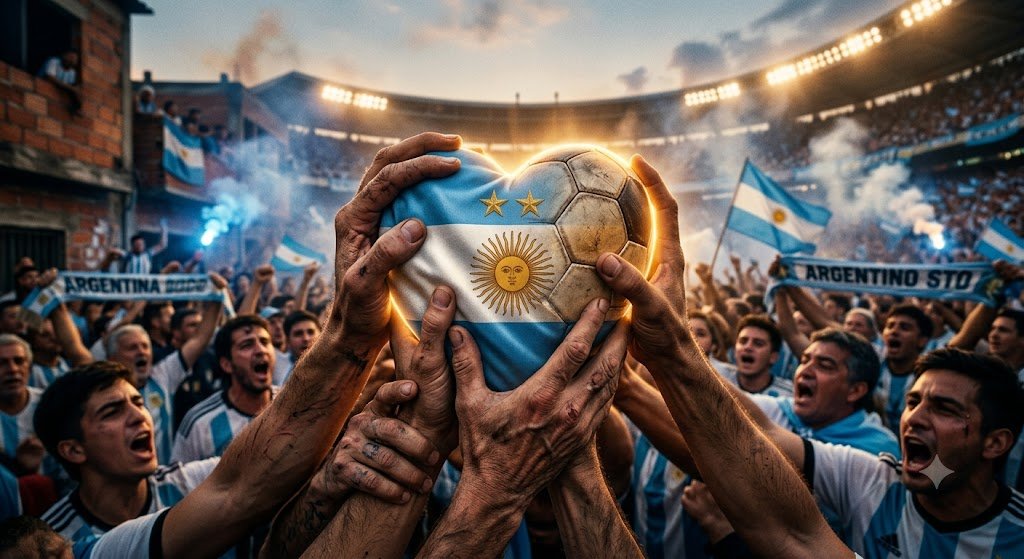
Argentina empieza ahí, en un corazón ofrecido sin garantías, en entregar la vida en cada juego. Porque eso es exactamente lo que pasa cada cuatro años: llega el Mundial y Argentina nos entrega, a todos, a los que estamos del otro lado de la pantalla, lo mejor de sí. No nos entrega una técnica, aunque la muestre. No nos entrega una estadística, aunque la logre. Nos entrega el alma, la vida.
Nada más puede darnos un país que ha fracasado en la economía hasta volver el fracaso un género literario. Un país que ha fracasado en los derechos humanos, que cargó dictadura y desaparecidos y una herida que todavía no cierra. Un país que ha fracasado hasta en caerle bien a otros países. Son tantas cosas que enumerarlas sería injusto y sería interminable, y sin embargo… cada vez que suena el himno de la albiceleste, ese país roto se vuelve, por noventa minutos, el lugar más entero del mundo.
Porque el fútbol en Argentina no se vive igual que en otros países. Es el alma de su gente entregándose por completo, sin reserva, sin cálculo, sin prudencia. Por eso no es un equipo, es una estrella o dos más un equipo, porque el argentino antes que ser jugador, antes que ser ciudadano, antes de nada, es individuo. Y quizá por eso, cuando llega el Mundial, la Argentina no parece entrar a la cancha como una nación organizada, sino como una suma desesperada de individualismos, de barrios, de familias, de amigos, de hijos, de padres, de voces sueltas que por fin encuentran una sola garganta.
Por eso Argentina va al Mundial a decir, con la voz quebrada: aquí se me va la vida. Va a probar, que todavía puede creer. Que todavía puede convertir su individualismo, su soberbia, su nostalgia y su herida en una sola fuerza colectiva. Argentina no juega solo para los argentinos. Juega para todos los que alguna vez necesitaron ver la materialización de que el resultado todavía podía torcerse, aunque sea a través de su personalidad desmesurada que compensa fracasos institucionales con épica, palabras, orgullo, talento y mito.
Por eso, cada juego se siente como parte del destino.
Es de esa entrega total, de esa necesidad de creer, que salen los genios. Sale Kempes y cambia la historia. Sale Maradona y cambia la historia. Sale Messi y cambia la historia. No aparecen porque Argentina sea una fábrica de talento. Aparecen porque un pueblo entero los necesitó tanto, los rogó tanto, los rezó tanto, que terminó pariéndolos. Y así, en medio de ese parto sufrido, los regala al mundo, porque Maradona no le pertenece solo a los argentinos. Maradona es napolitano. Maradona es mexicano. Maradona es colombiano. Maradona, Messi, elija el salvador de turno. Ese salvador que le pertenece a todos los que alguna vez en la vida necesitaron creer que bastaba el talento para vencer al orden, la grandeza, la potencia, la fuerza, el estado, la injusticia, el dinero, la constancia y le orden establecido. Algunas cosas buenas y algunas malas, pero todas son rotas por ese personaje. Y con el de la mano, entra la Argentina con sus partidas, con sus muertos, con sus canciones, con sus fantasmas, con sus abuelos que se fueron y nunca volvieron. Entra fracasada, y en ese fracaso habla casi sobrada porque solo con palabras puede ocultar su fracaso, y al final cae mal, cae mal que se crean tanto siendo tan poco. Hasta que la pelota rueda, y se les va la vida y entonces ese jardín seco se llena de destino y florece.
Brasil también gana, también deslumbra, también nos hace creer en algo. Pero en Brasil el destino queda tapado por el talento. Es tanto el talento, es tan desbordante, tan natural, que casi parece injusto. El brasileño juega como si Dios le debiera un favor y viniera a cobrarlo bailando. Argentina no. Argentina no se trata de talento. Argentina se trata de dar la vida. De sufrirla. De sudarla. De empuje. De entrañas. De rogarle a Dios una señal de que son sus hijos también, de que no todo es desgracia, de que no todo es sufrimiento.
Y Dios les responde.
De vez en cuando, casi cruelmente, les manda un solo genio en el grupo, uno, y que los otros diez salgan a puro amor, a pura garra, a puro dar la vida, a puras tripas, a romperse el cuerpo para que ese genio tenga dónde brillar. Porque él es la promesa cumplida de Dios, porque él es el recordatorio de que por ese tiempo, por esos minutos, Argentina no tiene que fingir ser el mejor, no tiene que escudarse en su personalidad insoportable. Cada jugador, cuando entra, no entra a jugar un partido. Entra a sostener una promesa casi divina. Entra cargando a todos los que sufren cantando. Entra a decirle al mundo, en nombre de un país que perdió casi todo lo demás: acá estamos, y aquí va nuestra vida.
Argentina, Destiny, and the World Cup
Argentina begins there, in a heart offered without guarantees, in giving one’s life in every game. Because that is exactly what happens every four years: the World Cup arrives, and Argentina gives us, all of us on the other side of the screen, the best of itself. It does not give us technique, though it shows it. It does not give us statistics, though it achieves them. It gives us its soul, its life.
What else can a country give us when it has failed economically to the point of turning failure into a literary genre? A country that has failed in human rights, that carries dictatorship and the disappeared, and a wound that still has not closed. A country that has failed even at being liked by other countries. There are so many things that listing them would be unfair and endless, and yet… every time the anthem of the Albiceleste plays, that broken country becomes, for ninety minutes, the most whole place in the world.
Because football in Argentina is not lived the way it is lived in other countries. It is the soul of its people giving itself completely, without reserve, without calculation, without prudence. That is why it is not a team; it is one star, or two, plus a team. Because the Argentine, before being a player, before being a citizen, before anything else, is an individual. And perhaps that is why, when the World Cup arrives, Argentina does not seem to enter the pitch as an organized nation, but as a desperate sum of individualisms, of neighborhoods, of families, of friends, of children, of fathers, of scattered voices that finally find one single throat.
That is why Argentina goes to the World Cup to say, with a broken voice: here, my life is leaving me. It goes to prove that it can still believe. That it can still turn its individualism, its arrogance, its nostalgia, and its wound into one collective force. Argentina does not play only for Argentines. It plays for everyone who has ever needed to see the material proof that the result could still be overturned, even if through its oversized personality, the one that compensates for institutional failures with epic, words, pride, talent, and myth.
That is why every game feels like part of destiny.
It is from that total surrender, from that need to believe, that the geniuses emerge. Kempes appears and changes history. Maradona appears and changes history. Messi appears and changes history. They do not appear because Argentina is a factory of talent. They appear because an entire people needed them so much, begged for them so much, prayed for them so much, that it ended up giving birth to them. And so, in the middle of that painful birth, Argentina gives them to the world, because Maradona does not belong only to Argentines. Maradona is Neapolitan. Maradona is Mexican. Maradona is Colombian. Maradona, Messi, choose the savior of the hour. That savior belongs to everyone who, at some point in life, needed to believe that talent was enough to defeat order, greatness, power, force, the state, injustice, money, consistency, and the established order. Some of those things are good and some are bad, but all of them are broken by that character. And with him by the hand, Argentina enters with its departures, with its dead, with its songs, with its ghosts, with its grandparents who left and never came back. It enters as a failure, and from that failure it speaks almost with arrogance, because only with words can it hide its failure. And in the end, it becomes unlikeable. It becomes unlikeable that they believe so much in themselves while being so little. Until the ball starts rolling, and their life begins to leave them, and then that dry garden fills with destiny and blooms.
Brazil also wins, also dazzles, also makes us believe in something. But in Brazil, destiny is covered by talent. There is so much talent, so overwhelming, so natural, that it almost seems unfair. The Brazilian plays as if God owed him a favor and had come to collect it by dancing. Argentina does not. Argentina is not about talent. Argentina is about giving one’s life. About suffering it. Sweating it. About drive. About guts. About begging God for a sign that they are His children too, that not everything is misfortune, that not everything is suffering.
And God answers them.
From time to time, almost cruelly, He sends them a single genius in the group, one, and lets the other ten go out with pure love, pure grit, pure life-giving, pure guts, breaking their bodies so that the genius has somewhere to shine. Because he is the fulfilled promise of God, because he is the reminder that for that time, for those minutes, Argentina does not have to pretend to be the best, does not have to hide behind its unbearable personality. Each player, when he enters, does not enter to play a match. He enters to uphold an almost divine promise. He enters carrying all those who suffer while singing. He enters to tell the world, in the name of a country that lost almost everything else: here we are, and here goes our life.