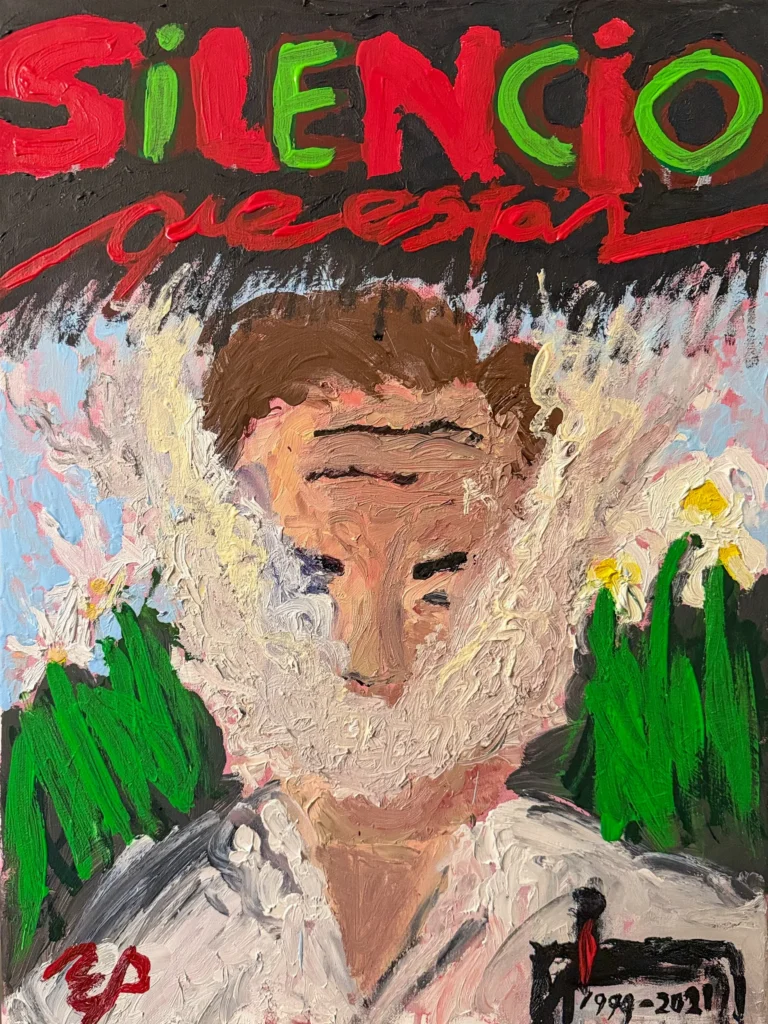
SILENCIO
Han pasado ya poco más de 15 días desde mi cumpleaños. 51 primaveras, literalmente. Aquí, en el autoexilio, en búsqueda de refugio, a mi edad, ya son más los libros y las historias que recuerdo que los que actualmente leo. El tema de hoy, amadísimos lectores, no es otro que una nueva pintura del inexperto que es su amigo. Esta ocasión, al igual que recientemente, he dedicado mucho tiempo a la autorreflexión.
Recientemente, se ha vuelto evidente para mí lo mucho que me cuesta estar callado, lo difícil que se ha vuelto el silencio para mí. Incluso ahora, mientras escribo, debo, cuasi per forza, leer en voz alta las palabras para continuar la permanente conversación conmigo mismo que, al parecer, se halla ahora abierta a cualquiera que vaya pasando por donde estoy. La realidad es que desde que dejé de fumar se ha abierto un grifo interminable de palabras, palabras que ejercían una enorme presión sobre mí, tanta que extinguieron el fuego de mi eterno cigarro. Cuatro meses casi sin aspirar el humo silenciador. En medio de ese borbotón desordenado de ideas, la estructura era tan fútil y abrumadora que apareció la pintura, como aparecen las cosas importantes: sin avisar, sin pedir permiso, como si siempre hubieran estado ahí, esperando su turno.
La “obra” o pintura que acompaña este texto se llama Silencio. Porque eso fue lo que viví durante muchos años: silencio.
No un silencio de paz ni de contemplación, sino el tipo de silencio espeso que se queda flotando en los cuartos después de conversaciones que nunca ocurrieron.
Como diría el afamado musical de Broadway Hamilton: “Nadie más estaba en la habitación donde ocurrió”.
Así pues, es ese silencio espeso que se queda flotando en esas habitaciones donde estuve y las cosas ocurrían. Silencio que no descansa en la boca, sino que se instala en los huesos y aprende a respirar con uno.
En la pintura estoy yo. Es un autorretrato.
Estoy con los ojos cerrados, como quien duerme, pero no duermo. Hay una diferencia que el cuerpo aprende con el tiempo: cerrar los ojos no siempre es descansar; a veces es resistir, otras es soportar, algunas más es, en medio del terror, esconderse, desaparecer. A veces es la única manera de no ver lo que no se puede cambiar, o lo que no se debe decir.
De mi boca sale humo. Ese humo es la única forma que encuentra mi voz para salir sin traicionarme. Palabras que se vuelven ese aire espeso, niebla, algo que ocupa espacio pero no deja evidencia. El humo no acusa, no señala, no deja testigos. Se disipa con la misma rapidez con la que uno aprende a callar. El humo cubre y deforma y cambia. Cambia porque el silencio tiene consecuencias. Callar va moviendo la cara de uno, va desdibujando sus contornos, va convirtiendo la propia identidad en algo incierto, como si uno fuera poco a poco borrándose a sí mismo para no incomodar al mundo y así poder sobrevivir en él. Quizás, tal vez como esas reglas que nunca se escriben pero que todos entienden.
Arriba del cuadro está la palabra “Silencio”. Y debajo de esta, casi como si alguien la hubiera dicho en voz baja para no despertar a nadie, está la frase: “que están”. Un recuerdo al bolero de Rafael Hernández Marín (Puerto Rico, 1932): “Silencio, que están durmiendo, los nardos y las azucenas, no quiero que sepan mis penas, porque si me ven llorando morirán…” Hermosísima canción que ha rondado en mi cabeza recientemente. Yo la escuché por primera vez de la voz de Chabelo. Aquel inolvidable comediante y conductor mexicano, que la cantaba cuando algún concursante pedía silencio mientras trataba de mantenerse arriba de la escalera loca. Chabelo entonces gritaba y asustaba al concursante mientras estridentemente cantaba: “¡Silencio! ¡Que están! ¡Durmieeeeeendooooooooo!…”
Hoy, viendo al pasado, por un instante me doy cuenta de que durante mis años de humo, no era yo más que un niño agarrado a la escalera loca mientras México, como Chabelo, me gritaba “¡Silencio! ¡Que están!…” todo el tiempo.
Porque un niño?, se preguntaran, tal vez, ustedes queridos amigos. Es vital explicar que en la pintura, a la izquierda hay nardos. A la derecha, azucenas. Flores de despedida. Flores que perfuman la ausencia. Flores que se quedan cuando alguien ya no está. Flores de muerto.
En 1999 murió mi abuelo.
Con él se fue algo más que una persona. Se fue mi forma de estar en el mundo. Él era mi figura de padre, mi referencia silenciosa, el lugar donde las cosas tenían sentido sin necesidad de explicarse. Cuando murió, no hubo un reemplazo: hubo adaptaciones, nuevos nombres, nuevas voces, nuevos caminos que aprender a recorrer. Cuando murió comenzó el silencio. Así de ensordecedor, como una transformación lenta.
Aprendí a callar.
Aprendí que a menudo el silencio no es una opción, es supervivencia.
A mis hijos siempre les digo: “No le pongas nombre a lo que no existe”, y sin embargo, hay cosas que existen aunque no se nombren. Esas cosas me rompieron y muchas veces mi salida fue transformarlas en humo. Un humo que salía, sí, pero que también se quedaba. Que envolvía, que cubría, que terminaba por deformarme sin que yo lo notara del todo.
Esta pintura es ese momento de reconocimiento. Una revelación silenciosa. Un instante en el que me veo desde fuera y entiendo, quizá por primera vez, el costo de haber callado tanto tiempo. Y también, de alguna forma, el sentido que tuvo. Todo silencio, cuando se sostiene lo suficiente, termina hablando.
Yo pinto esto sin pensar demasiado; ese es el regalo que me está dejando la pintura. La mano se mueve antes que la cabeza: cuando escribo, la cabeza nos lleva; cuando pinto, la mano manda.
Así, pintando, siento que no estoy callando.
Que estoy hablando.
Aunque sea en humo.
Aunque sea en capas de pintura.
Esto es lo que soy, y solo yo sé lo que sé y lo que entre humo callo.
Octavio Paz dice en su ensayo “Máscaras mexicanas”: “el mexicano se me aparece como un ser que se encierra y se preserva: máscara el rostro, máscara la sonrisa. Plantado en su arisca soledad, espinoso y cortés a un tiempo, todo le sirve para defenderse: el silencio y la palabra, la cortesía y el desprecio, la ironía y la resignación… en su silencio hay repliegues, matices, nubarrones, arco iris súbitos, amenazas indescifrables. Aun en la disputa prefiere la expresión velada a la injuria: ‘al buen entendedor, pocas palabras’. En suma, entre la realidad y su persona se establece una muralla, no por invisible menos infranqueable, de impasibilidad y lejanía. El mexicano siempre está lejos, lejos del mundo y de los demás. Lejos, también, de sí mismo“.
Así pues, al terminar esta pintura, que en su colorido me recuerda a mi vida cercana a la política mexicana, me veo obligado a acercarme a mi pasado, a mis razones, a mis dolores, a mis penas, a mis pecados, a mis arrepentimientos, a mis logros, a mis aciertos, a mis excesos, a mis contenciones, a mis exabruptos; pero sobre todo, a mi silencio: ese silencio que hoy, roto, me deja por momentos acercarme también a mí mismo.
SILENCE
It has been a little over 15 days since my birthday. 51 springs, literally. Here, in self-imposed exile, searching for refuge, at my age, the books and stories I remember already outnumber the ones I still read. Today’s subject, my dearest readers, is nothing other than a new painting by your friend, the amateur. This time, as has been the case recently, I have devoted a great deal of time to self-reflection.
It has become increasingly clear to me how difficult it is to stay quiet, how hard silence has become for me. Even now, as I write, I must — cuasi per forza — read the words aloud to keep going, to sustain the permanent conversation with myself that, apparently, is now open to anyone who happens to pass by where I am. The truth is that since I quit smoking, an endless faucet of words has been turned on — words that had been pressing against me with enormous force, so much so that they extinguished the flame of my eternal cigarette. Nearly four months without inhaling the silencing smoke. In the middle of that disordered torrent of ideas, the structure was so elusive and overwhelming that the painting appeared, the way important things always do: without warning, without asking permission, as if they had always been there, waiting their turn.
The “work,” or painting, that accompanies this text is called Silence. Because that is what I lived for many years: silence.
Not a silence of peace or contemplation, but the kind of thick silence that lingers in rooms after conversations that never happened.
As the celebrated Broadway musical Hamilton puts it: “No one else was in the room where it happened.”
That is exactly the kind of thick silence that floats through the rooms where I was present and things were happening. Silence that does not rest in the mouth, but instead settles into the bones and learns to breathe alongside you.
In the painting, there I am. It is a self-portrait.
My eyes are closed, like someone sleeping, but I am not asleep. There is a difference the body learns over time: closing your eyes is not always rest; sometimes it is resistance, sometimes it is endurance, and sometimes — in the middle of terror — it is hiding, disappearing. Sometimes it is the only way to avoid seeing what cannot be changed, or what must not be said.
From my mouth comes smoke. That smoke is the only way my voice finds to come out without betraying me. Words that become that thick air, that fog, something that occupies space but leaves no evidence. Smoke does not accuse, does not point fingers, does not leave witnesses. It dissolves as quickly as one learns to stay quiet. Smoke covers and distorts and changes. It changes because silence has consequences. Staying silent gradually shifts one’s face, blurs its contours, turns one’s own identity into something uncertain — as if one were slowly erasing oneself so as not to inconvenience the world, just to survive in it. Perhaps like those rules that are never written down but that everyone understands.
At the top of the painting is the word “Silence.” And below it, almost as if someone had whispered it so as not to wake anyone, is the phrase: “who are sleeping.” A nod to the bolero by Rafael Hernández Marín (Puerto Rico, 1932): “Silencio, que están durmiendo, los nardos y las azucenas, no quiero que sepan mis penas, porque si me ven llorando morirán…” A breathtakingly beautiful song that has been running through my head lately. I first heard it in the voice of Chabelo — that unforgettable Mexican comedian and television host — who would sing it whenever a contestant on his show asked for silence while trying to hold on to the crazy ladder. Chabelo would then shout and startle the contestant while belting out at full volume: “¡Silencio! ¡Que están! ¡Durmieeeeeendooooooooo!…”
Today, looking back, I realize for a moment that during my years of smoke, I was nothing more than a child clinging to the crazy ladder while Mexico, like Chabelo, was shouting “¡Silencio! ¡Que están!…” at me the whole time.
Why a child, you might ask, dear friends. It is important to explain that in the painting, on the left there are tuberoses. On the right, white lilies. Flowers of farewell. Flowers that perfume absence. Flowers that remain when someone is no longer there. Flowers for the dead.
In 1999, my grandfather died.
With him went something more than a person. My way of being in the world went with him. He was my father figure, my silent reference point, the place where things made sense without needing to be explained. When he died, there was no replacement: there were adaptations, new names, new voices, new paths to learn to walk. When he died, the silence began. That deafening, like a slow transformation.
I learned to stay quiet.
I learned that silence is often not a choice — it is survival.
I always tell my children: “Don’t put a name to what doesn’t exist.” And yet, there are things that exist even when they go unnamed. Those things broke me, and many times my way out was to turn them into smoke. Smoke that rose, yes, but also lingered. That wrapped around, that covered, that ended up distorting me without my fully noticing.
This painting is that moment of recognition. A silent revelation. An instant in which I see myself from the outside and understand, perhaps for the first time, the cost of having stayed quiet for so long. And also, in some way, the meaning it had. Every silence, when held long enough, eventually speaks.
I paint this without thinking too much; that is the gift the painting is giving me. The hand moves before the head: when I write, the head leads; when I paint, the hand commands.
And so, painting, I feel that I am not staying silent.
That I am speaking.
Even if it is in smoke.
Even if it is in layers of paint.
This is what I am, and only I know what I know and what I have kept quiet in smoke.
Octavio Paz writes in his essay “Mexican Masks”: “The Mexican appears to me as a being who shuts himself in and preserves himself: a mask for the face, a mask for the smile. Rooted in his sullen solitude, prickly and polite at the same time, everything serves him as defense: silence and the word, courtesy and contempt, irony and resignation… in his silence there are withdrawals, nuances, storm clouds, sudden rainbows, indecipherable threats. Even in argument he prefers veiled expression to outright insult: ‘a word to the wise is sufficient.’ In short, between reality and his person a wall is established — not the less impenetrable for being invisible — of impassivity and distance. The Mexican is always distant, far from the world and from other people. Far, too, from himself.”
And so, upon finishing this painting — whose colors remind me of my life close to Mexican politics — I find myself compelled to draw near to my past, to my reasons, to my sorrows, to my grief, to my sins, to my regrets, to my achievements, to my good decisions, to my excesses, to my restraints, to my outbursts; but above all, to my silence: that silence which today, broken, allows me — at least for moments — to draw near to myself as well.